Frederick Tyler
The Dark ForestFrederick Tyler, known as the First Wallfacer, is a former US secretary of defense and former president of the United States. His importance lies in the collision between his public identity as a strategist and the secrecy demanded by the Wallfacer Project: while the sophons make every communicated human plan visible to the Trisolarans, Tyler is entrusted with conceiving a counterstrategy entirely within his own mind. His eventual exposure transforms him from a symbolic defender of humanity into a man publicly branded as its enemy, revealing how quickly strategic ambiguity can become a mechanism of humiliation and collective delusion.
Identity and Political Background
Tyler enters the project with a reputation already formed on the world stage. He is tall and thin, wears square-framed glasses, and has recently retired from the office of US secretary of defense when Secretary General Say announces his selection before the United Nations assembly. The silence surrounding his rise to the rostrum emphasizes that the appointment is not a ceremonial honor. The audience recognizes a political actor whose decisions have shaped national strategy, and his elevation makes him one of the four people authorized to build a plan beyond the reach of ordinary institutions.
His strategic thinking is associated with his book The Truth of Technology. There he argues that technological progress weakens the traditional advantages of large states while increasing the leverage of small ones. Population and resources matter less as technology advances; nuclear weapons, for example, allow a country of only a few million people to threaten a country of a hundred million. Tyler therefore sees technological development as a force that can rearrange global power rather than simply magnify the strength of existing great powers. His ideas provide a theoretical foundation for the United States’ global war on terror, but the narrative also stresses that he is a man of action, not merely a theorist.
The First Wallfacer
The Wallfacer Project is created because the sophons have made Earth strategically transparent. Additional sophons continue to enter the Solar System, allowing the Trisolarans to observe meeting rooms, files, computers, military details, and newly formed plans. Human communication produces leaks, yet the Trisolarans’ direct mode of thought leaves them deficient in tricks, camouflage, and deception. The project consequently rests on a narrow remaining refuge: sophons can read language and stored information, but cannot read uncommunicated human thoughts.
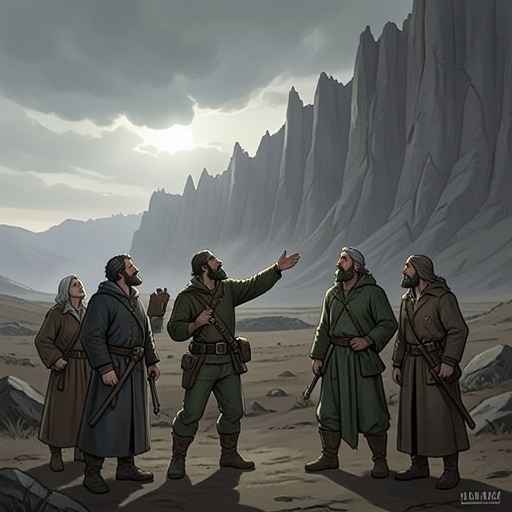
As a Wallfacer, Tyler is expected to formulate his strategy internally and to direct its execution while presenting the world with false signals. The entire world, ally and enemy alike, becomes the object of his intended misdirection. This role gives him immense authority but also makes his public behavior impossible to interpret with confidence. A gesture may be a disguise, a demand may conceal an opposite objective, and apparent failure may be part of a design whose true purpose exists only in his mind.
His first disclosed proposal is startlingly direct. Tyler says that he needs to establish an armed force in space to supplement Earth’s fleet while remaining under his command. The other two active Wallfacers immediately object, since their own plans have already been accused of consuming excessive resources. The demand appears to exceed even the exceptional privileges granted to a Wallfacer: Tyler is seeking a personal space force rather than merely an institutional defense program.
The Mosquito Swarm Plan
Tyler’s principal project becomes a fleet of small space fighters, later called the mosquito swarm. At a later hearing he revises the plan so that every fighter will possess two control systems: one operated by a pilot and one operating as a drone mode under Tyler’s centralized command. He imagines the fleet traveling to the battle zone in a compact group, separating and reforming as required, and then using autonomous targeting so that each fighter can select and attack its own target. He expects advances in artificial intelligence over the following three centuries to make this possible even while the fundamentals of physics remain locked down.
The plan eventually receives approval, although development proceeds slowly because humanity lacks advanced technologies. The surrounding military effort is described in deliberately modest terms: civilization is improving the technology of its stone-age axes and clubs while inventing chemically propelled rockets. Tyler also proposes a supplementary study of Europa, Ceres, and various comets. Its oddness leads some observers to suspect that it exists mainly to make his otherwise transparent main plan appear mysterious, but it is accepted because it can be incorporated into the mainstream defense program.
Tyler’s insistence on control gives the project a personal as well as military character. The two control systems preserve ordinary human operation while allowing him to assume command of the entire formation. His imagined battlefield is therefore neither a conventional fleet action nor a purely autonomous attack. It is a hybrid force designed to look dispersed and flexible while remaining coordinated by a single Wallfacer whose intentions are supposed to be unreadable.
Exposure and Collapse
After five years as a Wallfacer, Tyler is increasingly scrutinized by the public. The Wallfacers have become messiah figures, surrounded by a cult that credits them with supernatural abilities and treats them as humanity’s sole hope. Their fame grants them political and material capital, but it also turns every failed prediction and every unusual request into a public spectacle. Tyler waits through slow development under this burden, eventually returning home and living as a normal person for the first time in years.
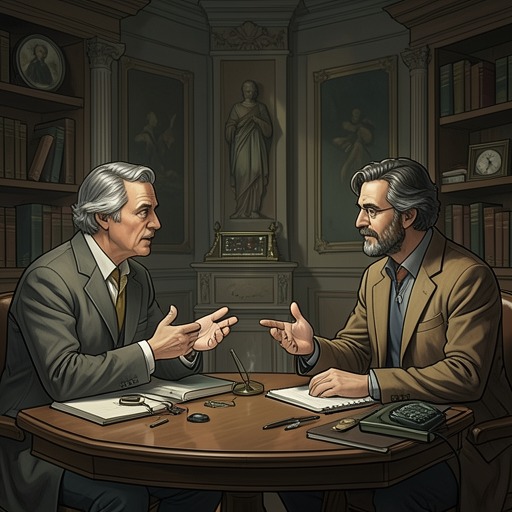
His crisis begins when his Wallbreaker appears. Tyler tells Luo Ji that the Wallbreaker arrived four days earlier, and the revelation leaves him physically and emotionally stunned. The Wallbreaker’s explanation identifies the mosquito swarm’s first target not as the Trisolaran invaders but Earth’s own space force. Tyler’s worldwide search for a human kamikaze force had failed in its overt purpose, yet that failure was interpreted as serving another design: it produced total despair in humanity. The Wallbreaker also concludes that Tyler’s plan was built around a further concealed objective, which is exposed before Tyler can preserve the mystery.
The revelation destroys Tyler’s composure. His features slacken, he collapses into the sofa, and the narration presents him as finished before the final consequences of the disclosure have even unfolded. The physical collapse makes the failure of the Wallfacer persona visible: the man who was supposed to maintain an impenetrable inner strategy can no longer sustain the public performance once another mind has reconstructed it.
Tyler then breaks down publicly. After the PDC meeting is adjourned, he flees into the square shouting that he is Wallfacer Frederick Tyler, that his Wallbreaker has exposed his strategy, and that he intends to attack Earth’s fleet with the mosquito swarm. He calls himself anti-human and a devil and demands punishment and death. The outburst is judged meaningless, but it expresses his rage at being trapped inside an image that no longer belongs to him.
What he hates most is the expression on the surrounding crowd’s faces. Their eyes combine the fantasies of children, the reverence of middle-aged observers, and the concern of the elderly. They believe that Tyler is secretly carrying out a magnificent plan known only to himself, pretending so convincingly that the enemy cannot discover it. His anger is directed not only at the Wallbreaker but at the entire social machinery that converts uncertainty into worship. The crowd’s faith survives the exposure by reinterpreting the exposure as another layer of strategy, leaving Tyler unable to reclaim either his innocence or his intended secrecy.
Historical and Thematic Significance
Tyler’s fate embodies the security dilemma at the heart of the Wallfacer era. Humanity must hide its intentions because the Trisolarans can observe every external communication, yet the very attempt to conceal a plan causes allies and enemies to interpret ordinary defense as possible aggression. Tyler’s proposed armed force can be read as a supplement to Earth’s fleet, a privately controlled instrument, or a weapon aimed at humanity itself. Once the Wallbreaker supplies a coherent interpretation, the ambiguity that was meant to protect Tyler becomes evidence against him.
His story also exposes the limits of information without trust. The public knows that the Wallfacers must deceive, so no apparent statement can be accepted at face value. Even Tyler’s confession in the square fails to restore clarity because observers assume that the confession itself may be part of the plan. This is the inverse of total transparency: nothing remains secret, yet nothing can be understood securely. Tyler’s collapse is therefore both personal and systemic, produced by a civilization that needs strategic deception while demanding visible reassurance from the people who practice it.
The later history surrounding Earth confirms the scale of the forces Tyler was trying to manipulate. The annihilation of the combined fleet revives Escapism, while the rise of the space fleet as a suprastate entity shows that political power has shifted away from the old great powers. In the underground city, fires, falling debris, chaos, despair, and ecstatic indulgence reveal a society whose institutions are losing control of public feeling. Tyler’s earlier attempt to weaponize despair thus belongs to a wider historical pattern: under existential pressure, collective fear can become a military resource, a political force, and finally a condition that consumes the distinction between defense and betrayal.
His character also resonates with the cosmic logic later articulated in conversation with Shi Qiang: even a benevolent civilization cannot determine at the beginning of communication whether the other civilization is benevolent. That uncertainty makes exposure dangerous in itself. Tyler acts within a world where intentions cannot be verified, where the enemy’s technological future must be imagined, and where a defensive measure may appear indistinguishable from a first strike. His significance is not that he provides a successful solution, but that his ruin demonstrates the human cost of trying to command history from behind an unreadable face.